Startups and SaaS
User accounts, analytics, payments, support chats and a long list of vendors that each touch personal data.
India's Digital Personal Data Protection Act applies to any business that holds customer data: startups, clinics, schools and online stores. We run a practical DPDP Readiness Assessment and give you a clear list of what to fix first.
The Act covers digital personal data of people in India. It does not matter whether you are a ten-person startup or a large company. As of November 2026 we have found no notified exemption for startups or small businesses, so we advise planning as if it applies.
User accounts, analytics, payments, support chats and a long list of vendors that each touch personal data.
Patient records, prescriptions and reports. Health data is among the most sensitive data you hold.
Student and parent data. The Act has stricter duties for children's data.
Customer addresses, phone numbers, order history, marketing lists and payment partners.
A short, practical review in plain language. You get a Readiness Report you can act on, not a stack of legal jargon.
We list every place personal data lives: sheets, CRM, WhatsApp, email and vendor tools, and why you collect each item.
We compare what you do today with what the Act expects on notice, consent, security safeguards, deletion, vendors and breach response.
A prioritised fix list with owners and next steps, so your team knows what to do this month and what can wait.
It is a practical readiness review. It is not a legal opinion, a statutory audit or a certificate of compliance, and we do not use those words for it.
Want to know the cost and timeline for your business? Write to info@kushaai.com and tell us your business type and team size.
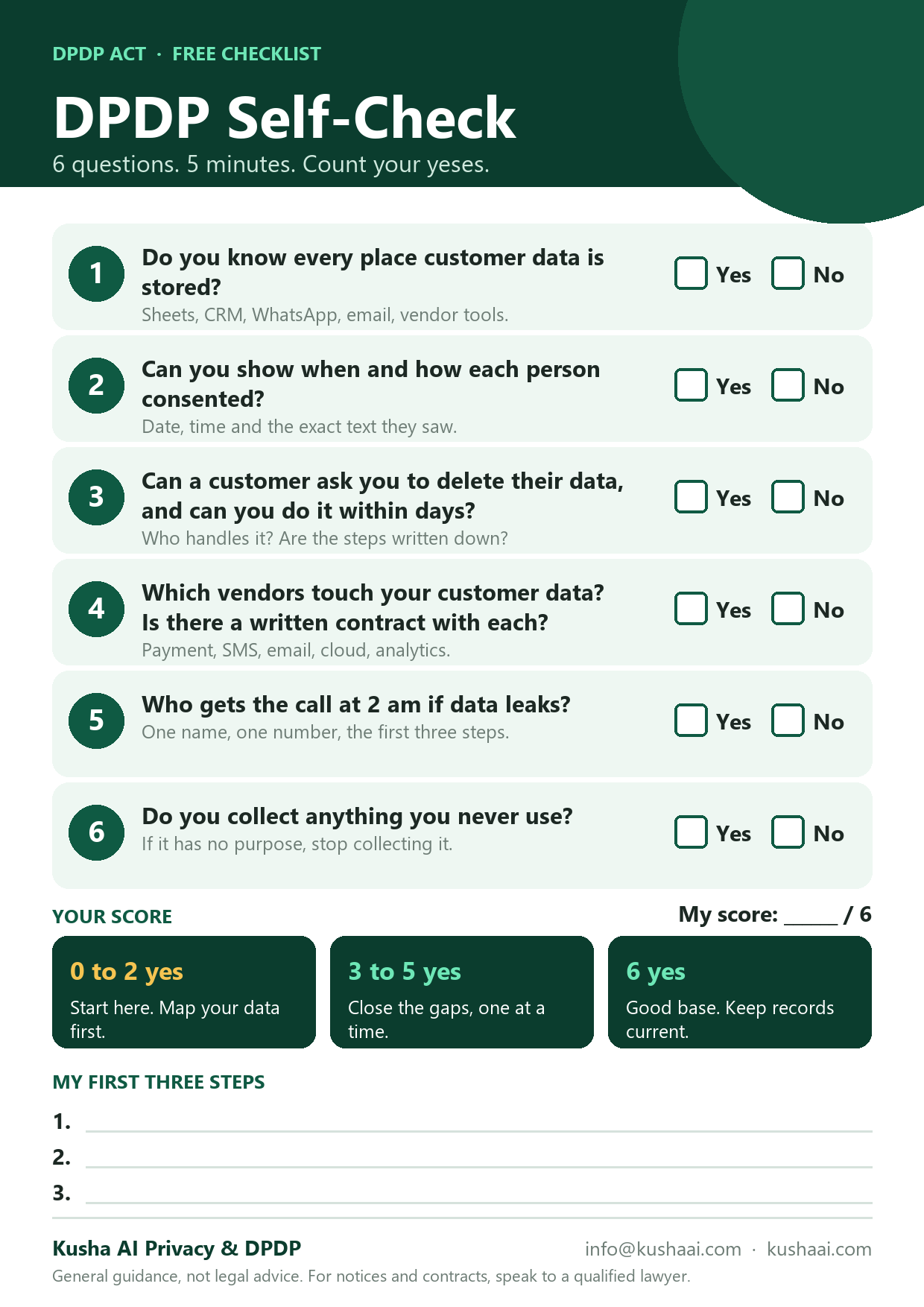
Tick every question you can answer with a confident yes. We store nothing and the result is not sent to us. It stays in your browser.
Tick the questions you can answer with a yes.
This self-check is a starting point for your own thinking, not legal advice.
The same six questions in a printable one-page PDF. Share it with your team and tick it off together.
These are maximum amounts, set by the Data Protection Board after an inquiry. They are not fixed fines, and the Board looks at the facts of each case.
| What goes wrong | Penalty ceiling |
|---|---|
| Not keeping reasonable security safeguards | Up to ₹250 crore |
| Not reporting a personal data breach | Up to ₹200 crore |
| Not meeting the rules for children's data | Up to ₹200 crore |
| Extra duties of a Significant Data Fiduciary | Up to ₹150 crore |
| Other breaches of the Act | Up to ₹50 crore |
Source: the Digital Personal Data Protection Act, 2023, Schedule. Primary text of the Act and Rules is published by the Ministry of Electronics and Information Technology (MeitY).
The Digital Personal Data Protection Act, 2023 is India's law on how businesses collect, use, store and protect personal data. The DPDP Rules were notified in November 2025. Businesses that decide why and how personal data is processed are called Data Fiduciaries.
The main duties for businesses (notices, consent, security safeguards, breach reporting and handling people's rights) apply from 13 May 2027, which is 18 months after the Rules were notified. The rules for Consent Managers came into force on 13 November 2026.
As of November 2026 we have found no notified exemption for startups or small businesses. The Act allows the government to notify exemptions for some classes of businesses, but we know of none for startups. We advise planning as if it applies to you.
The ceiling is up to ₹250 crore for failing to keep reasonable security safeguards. It is up to ₹200 crore for failing to report a breach or for breaking the rules on children's data. These are maximums, set by the Data Protection Board after an inquiry. They are not fixed fines.
It is a practical review of where your business stands against the main DPDP duties. We map where personal data lives, compare what you do today with what the Act expects, and give you a Readiness Report with a prioritised list of fixes. It is not a legal opinion, an audit or a certificate.
Download the one-page PDF from this page. It has six questions you can answer in about five minutes. You do not need to enter an email address or any other detail.
Tell us what your business does, how big your team is and what customer data you hold. We will reply with how we would approach it.